Best practices for MIG welding mild steel
- Wire stick-out: Stick-out
is the length of unmelted electrode extending from the tip of the
contact tube and it does not include arc length. Generally, maintain a
stickout of 3/8 inch and listen for a sizzling bacon sound. If the arc
sounds irregular, one culprit could be that your stickout is too long,
which is an extremely common error.
- Push vs. pull: The push or forehand technique
involves pushing the gun away from (ahead of) the weld puddle. Pushing
usually produces lower penetration and a wider, flatter bead because the
arc force is directed away from the weld puddle. In addition, pushing
usually offers a better view and enables you to better direct wire into
the joint. With the drag or backhand technique (also called the pull or
trailing technique), the welding gun is pointed back at the weld puddle
and dragged away from the deposited metal. Dragging typically produces
deeper penetration and a narrower bead with more buildup.
- Travel angle: Travel angle is defined as the
angle relative to the gun in a perpendicular position. Normal welding
conditions in all positions call for a travel angle of 5 to 15 degrees.
Travel angles beyond 20 to 25 degrees can lead to more spatter, less
penetration and general arc instability.
- Work angle: Work angle is the gun position
relative to the angle of the welding joint, and it varies with each
welding position and joint configuration (see below).
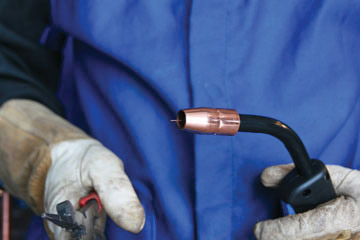
Flat position welding
- Butt weld (a 180-degree joint). Hold the gun at
a 90-degree angle to the workpiece, directing the filler metal straight
into the joint (but don't forget to include your travel angle of 5 to
15 degrees). A small, back-and-forth motion with the gun can help fill a
large gap or when making multiple passes. A slight pausing at the side
of a weave bead can help avoid undercut.
- T-joint (a 90-degree joint; the type of weld on
this joint is called a fillet weld). Keep the gun at a 45-degree angle,
or equal distance from each piece. When making multiple weld passes,
the work angles change slightly. This helps avoid uneven weld beads and
undercuts.
- Lap joint (also a fillet weld). Angle the gun between 60 and 70 degrees. The thicker the metal being welded, the greater the angle.
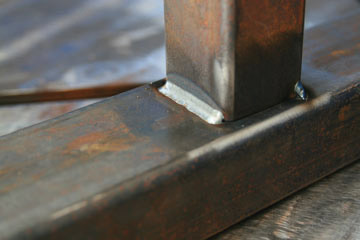
Horizontal position tips
Because of the effects of gravity, the gun work angle must be dropped
slightly by 0 to 15 degrees. Without changing the work angle, the
filler metal may sag or rollover on the bottom side of the weld joint.
The travel angle, whether using a push or a drag technique, generally
remains the same as for a weld joint in the flat position.
When making multi-pass welds on thick metal, or to bridge a slight
gap where fit-up is poor, weave beads may be used to fill a weld joint. A
slight hesitation at the top toe of the weld helps prevent undercut and
ensure proper tie-in of the weld to the base metal.
Voltage and amperage settings for welding in the horizontal position
are usually the same or slightly less than settings for welding in the
flat position.
Tips for welding in vertical positions
Vertical MIG welding, both up and down, can be difficult. This makes
pre-weld set-up very important for making high quality welds. Since you
are fighting gravity, consider reducing the voltage and amperage 10 to
15 percent from the settings for the same weld in the flat position.
The vertical down technique helps when welding thin metals because
the arc penetrates less due to the faster travel speed. Because vertical
down welding helps avoid excessive melt-through, welders sometimes
place very thin materials in the vertical position even if they can weld
them in the flat position. When welding vertical down, begin at the top
of a joint and weld down. For thin metal where burn-through is a
concern, direct the wire away from the weld puddle. Keep the electrode
wire on the leading edge of the weld puddle. A very slight weave may
help flatten the weld crown.
With the vertical up technique, begin is beginning at the bottom of a
joint and welding up. This can provide better penetration on thicker
materials (typically 1/4 inch or more). The travel angle of the gun is a
5 to 15 degree drop from the perpendicular position. A slight weaving
motion can help control the size, shape and cooling effects of the weld
puddle.
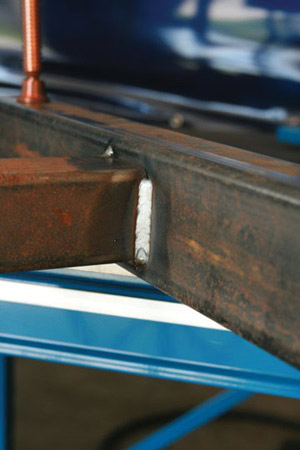
Overhead position welding
Drag, push or perpendicular gun techniques can be used for MIG
welding overhead. But because of gravity, travel speeds must be fast
enough so that the weld metal does not fall out of the joint. Also for
this reason, weave beads should not be too wide. Lowering the voltage
and amperage help keep the weld puddle small and more controllable
(which is why you might want to consider using a smaller diameter wire).
Practice, practice, practice!
Note that travel speed — the rate at which you move the gun along the
joint — influences the shape and quality of a weld bead to a
significant degree. Many experienced MIG welders determine the correct
travel speed by judging the weld puddle size in relation to the joint
thickness. Knowing that a weld bead needs to be no larger than the
thinnest section of metal being welded, they adjust their travel speed
accordingly. They also keep the arc on the leading edge of the puddle
and don't let the molten metal get ahead of them.
Most people can create good-looking, high quality MIG welds with a
combination of practice and following the techniques discussed.


